Soluciones Kenko · 7/29/2026
A QMS that lives where your team already works
We built a quality management system on Google Workspace: one source of truth for documents, audits, and client engagements, designed for people and AI agents alike.
Quality systems fail quietly. Spreadsheets diverge from the procedures on Drive. Review dates slip. Audits live in another folder. When a client asks for evidence, someone spends an afternoon reconstructing what should have been obvious.
We needed something better for our own ISO 13485 and NOM-241 work, and for the quality systems we design and transfer for other organizations. So we built a QMS web app on Google Apps Script and Drive: collaborative by default, auditable by design, and readable by both people and AI agents.
One source of truth
We stopped treating the document matrix as the master. Each controlled document holds its own status, signatures, risk rating, and review date. The matrix is generated from those documents, so the list and the files cannot disagree.
That same model covers:
- Document control and electronic signatures
- Internal audits and supplier audits
- Client diagnostics for QMS transfer or build-out
- A hash-chained audit log for who changed what, and when
Teams collaborate in Workspace. Quality still owns the lifecycle.
Visual and interactive
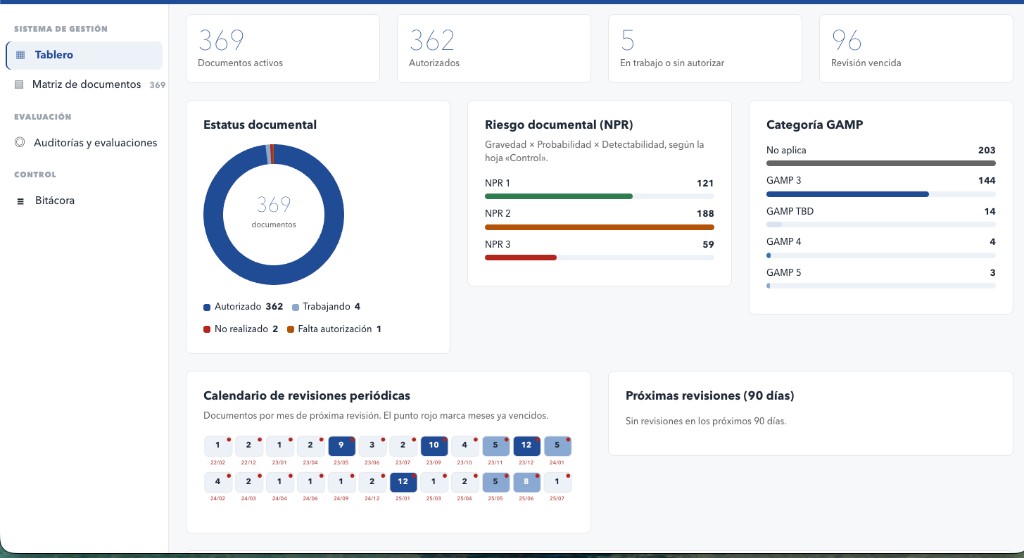
The dashboard is the operational view of the system: active documents, authorization status, overdue reviews, NPR distribution, GAMP breakdown, and the periodic review calendar. You see where the system is healthy and where it needs attention without opening three spreadsheets.
Charts and matrices are first-class in the UI, not exports someone has to refresh by hand. Status, risk, and review pressure are visible in one place.
Agentic workflow
The data contract is public to the system itself. Conventions live next to the documents so a person or an agent can orient without reading application code. Agents can propose updates against Markdown and frontmatter; people confirm before anything becomes official.
That matters when you run your own QMS and when you write QMS content for clients. Routine structure work (indexing, checklists, draft updates) can move faster without skipping authorization.
Corporate stack, lower cyber risk
The app runs inside Google Workspace under domain access. There is no separate SaaS account holding your controlled documents, no third-party database to harden, and no shadow folder tree outside corporate identity.
Users authenticate as themselves. Signatures and log entries attach to real accounts. Permissions follow the organization you already trust for email and Drive. For regulated work, that is not a convenience. It is a control.
Built for us, ready for others
We use this system for Soluciones Kenko. We also use the same patterns when we deliver quality management as a service: diagnostics, document matrices, audit engines, and transfer packages that clients can operate after we leave.
If your QMS still depends on a master spreadsheet and tribal knowledge, the fix is not another template. It is a single system your team can open every day, and that auditors and agents can read without translation.
Article details
- Author
- Soluciones Kenko
- Published
- 7/29/2026
- Category
- Digital Transformation